
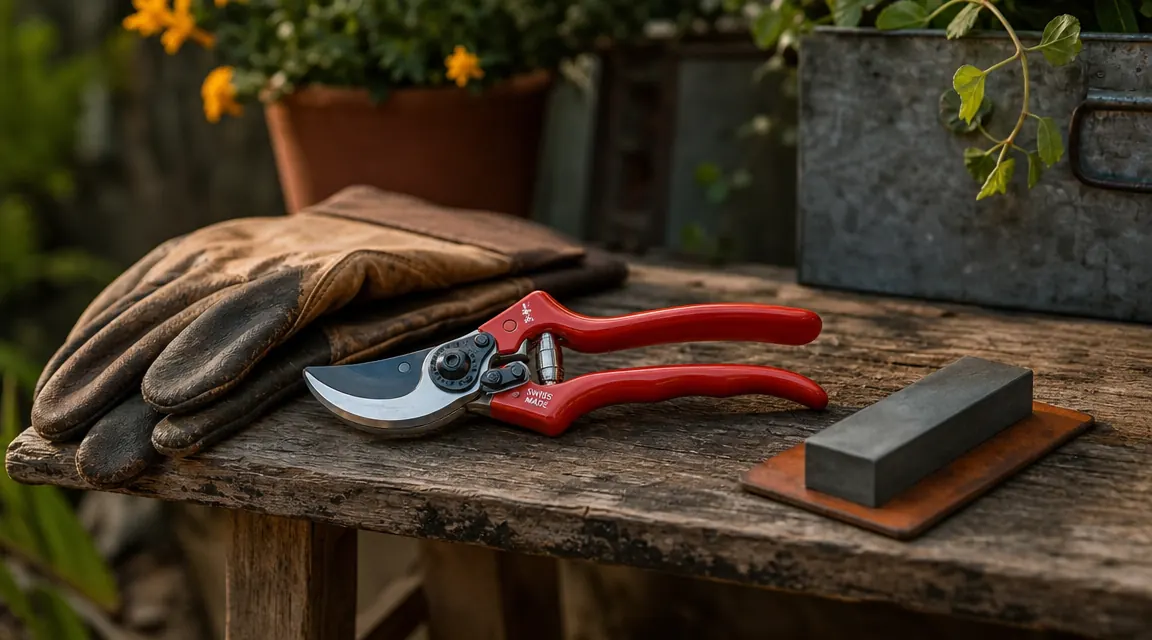
Search for the best bypass pruner and the Felco F5 shows up in the first three results on almost every gardening site. It has over 31,000 reviews on Amazon, a 4.8-star average, and a reputation that goes back decades. I bought mine after getting tired of cheap pruners that either dulled after six weeks or developed a sloppy pivot that turned clean cuts into crushed stems. The F5 earned its reputation. But there are things nobody mentions before you hand over your money, and a few of them matter enough to affect whether the F5 is actually the right pruner for your specific situation.
This is not a takedown. The Felco F5 is genuinely well made and the price is defensible once you understand what you are paying for. What I want to do here is fill in the gaps that most reviews skip: the sizing issue that trips up a significant portion of buyers, the one ergonomic quirk that gets worse in wet conditions, what the 'lifetime replaceable parts' claim actually means in practice, and the specific use cases where you are better served by a different tool.
The Quick Verdict
The Felco F5 is a well-engineered Swiss pruner that earns its reputation for edge retention and build quality. Buy it if you have large hands and prune woody growth regularly. Skip it if your hands run medium or small, or if your cutting tasks are light and occasional.
Amazon Check Today's Price →Still buying cheap pruners that dull in six weeks? The F5 fixes that problem at the source.
The Felco F5 uses hardened Swiss steel, adjustable blade tension, and a fully replaceable-parts system. It is the pruner you buy once and maintain for years. Check today's price on Amazon before your next pruning session.
Amazon Check Today's Price on Amazon →The Sizing Problem Nobody Warns You About
This is the most common source of buyer disappointment with Felco pruners, and it is almost never highlighted in mainstream reviews. The F5 is Felco's large-hand model. The grip is scaled up in circumference and overall length compared to the standard F2. If your hands measure medium or smaller, the F5 will sit wrong in your palm. You will lose mechanical advantage on the cut because your fingers will not wrap far enough around the lower handle to generate full closing force. Over a long pruning session, that means more hand fatigue, not less.
Felco makes three grip sizes for right-handed gardeners: the F6 for small hands, the F2 for average hands, and the F5 for large hands. The distinction is not subtle. The F5 grip circumference runs about 15 percent wider than the F2. If you are buying without ever holding one, a rough guide is this: if your glove size is large or XL, the F5 is likely the right fit. Medium glove, start with the F2. Small glove, look at the F6. Getting the wrong size is not just an ergonomic issue. It genuinely affects cutting performance and joint stress across a full gardening session.
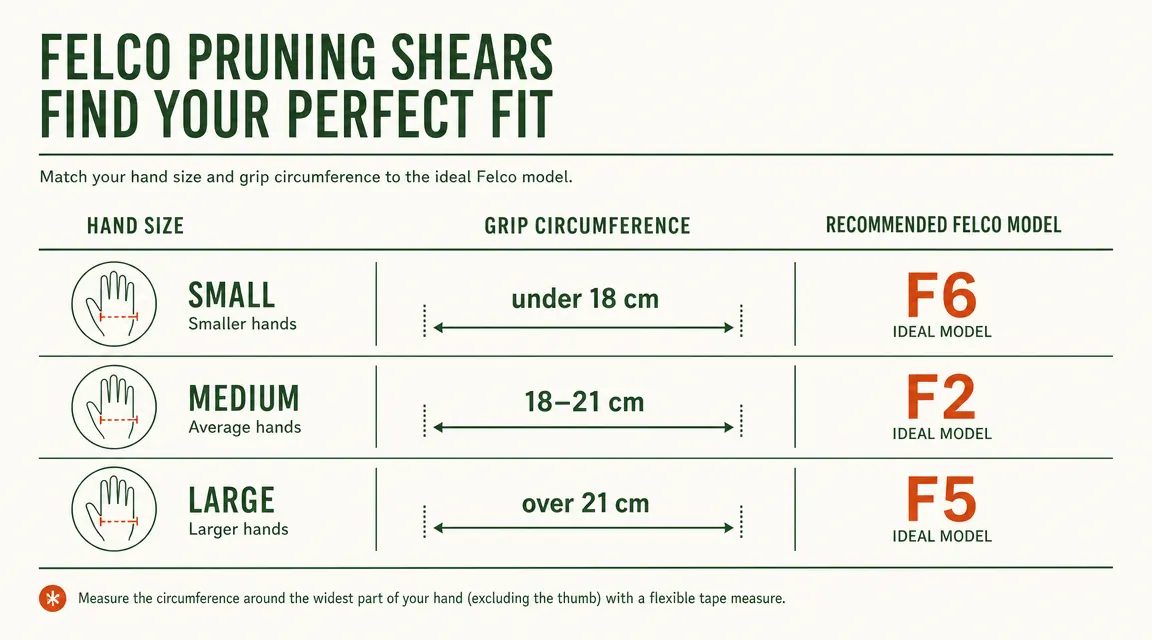
The retail packaging for the F5 says nothing prominent about this. The grip size information is buried in the product description. Felco does publish a hand-size guide on their website, but most people discover the sizing issue after the pruner arrives and they try it in the garden. Check your glove size before you order. It is worth the extra thirty seconds.
The Lock Mechanism: Fine in Dry Conditions, Annoying in the Garden
The Felco F5 uses a rotating lever lock on the lower handle. You push the lever forward with your thumb to close and lock the blade for safe carry and storage. To open it, you pinch the lever and rotate it back. The mechanism is reliable. It does not slip open in a tool bag or a back pocket. But it requires a deliberate two-finger pinch to release, and when your hands are wet or gloved, that deliberate pinch becomes noticeably awkward.
In real garden conditions, your hands are rarely clean and dry. Morning dew on plants soaks through gloves. You wash your hands between tasks and forget to dry them fully. You are kneeling in the dirt and the grip of your gloves is loaded with clay. In any of those scenarios, the rotating lock takes more fumbling to release than it should. Some gardeners adapt to this quickly and stop noticing it. Others find it genuinely irritating over a long session where they are picking the pruner up and setting it down repeatedly.
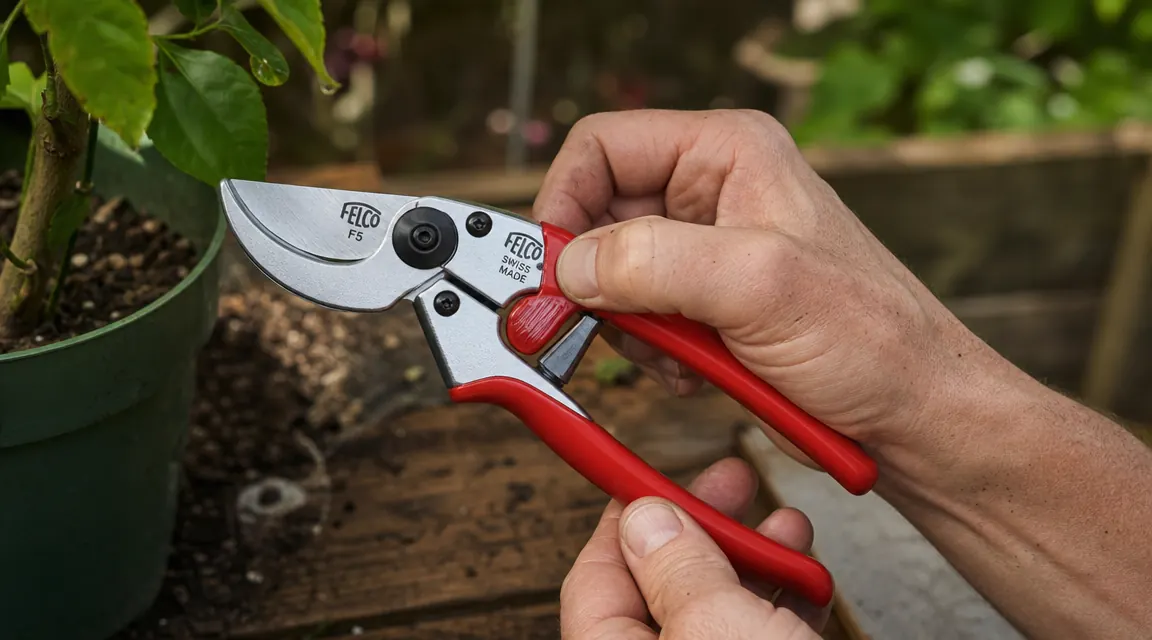
This is not a dealbreaker. Other pruners in this price range use a squeeze-to-open safety that can accidentally release in a pocket, which is a worse problem. The Felco approach prioritizes safe carry over quick access. That is a reasonable engineering choice. But it is not what you picture when you imagine smoothly reaching for your pruner mid-session, opening it with one hand, and getting back to work.
The 'Swiss Made' Premium: Is It Real or Is It Marketing
The Felco F5 is manufactured in Switzerland. That claim is accurate and the build quality reflects it. The forged aluminum handles are solid, not stamped. The blade geometry is consistent unit to unit in a way that mass-produced budget pruners are not. The steel is hardened at a level that gives you real edge retention across months of regular use. When gardeners say the Felco 'just feels different' from a hardware store pruner, that feeling is grounded in something real.
That said, Felco does not publish the specific steel alloy grade or Rockwell hardness number for the F5 blade. For a company that markets on precision and quality, that transparency gap is frustrating. You are buying on reputation and performance rather than published specifications. The performance holds up to scrutiny, but if you are the kind of buyer who wants to see the data behind the claim, Felco is not going to give it to you. You will find the same gap in most consumer pruner specs, including Fiskars, but it is worth noting on a tool at this price.
The 'Swiss made' claim is real. The build quality is real. Just know that Felco will not show you the spec sheet to prove it. You are buying on performance, not paperwork.
What the Replaceable Parts Promise Actually Means
Felco sells replacement blades, counter blades, springs, pivot bolts, grip inserts, and wire-cutting notch components for the F5. Every part of the tool can be replaced individually. This is the most compelling long-term cost argument for the Felco: when something wears, you fix it rather than buying a new tool. A replacement blade runs around $18 to $20 depending on the retailer. A replacement spring is a few dollars. If you keep the tool maintained, the replaceable-parts design does make the Felco cheaper than cycling through $20 pruners indefinitely.
The part that the marketing glosses over is that doing the replacement requires some mechanical comfort. Swapping the blade means disassembling the pivot, which involves a bolt, a washer, and getting the tension right when you reassemble. It is not complicated, but it is not a thirty-second job the first time you do it. Felco provides an instruction sheet and there are good video guides available online. The point is that the 'replaceable for life' promise requires you to engage with the tool as something you maintain, not just use. If you prefer to just use a tool and never think about it, that maintenance relationship might feel like more than you bargained for.
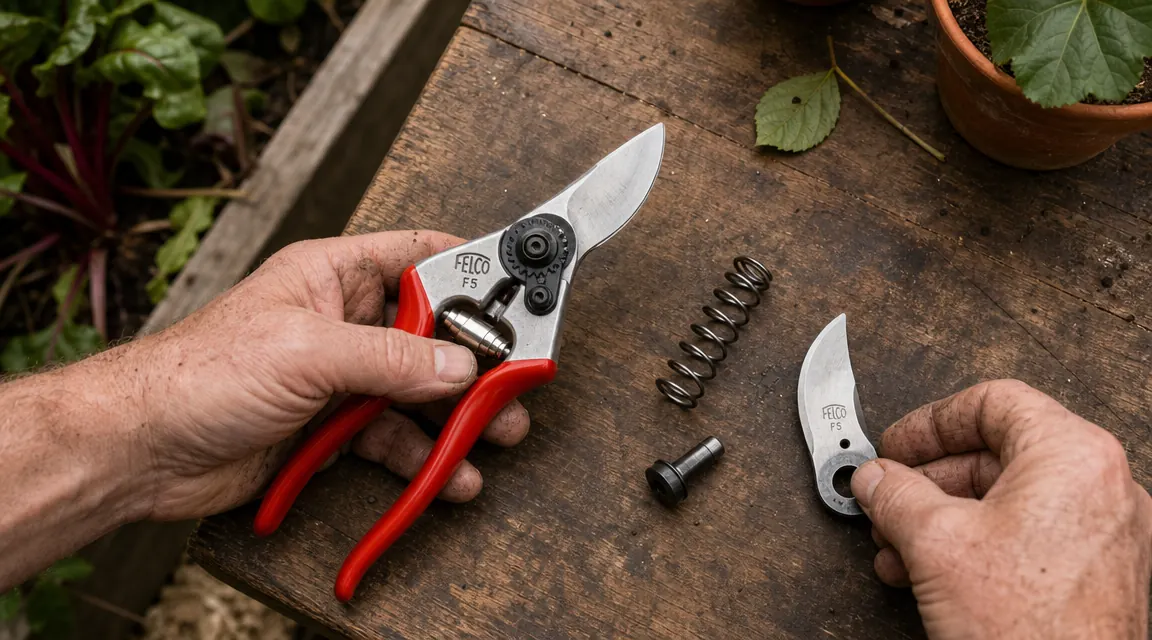
If you do engage with it, the reward is real. The blade pivot is also adjustable with a wrench, letting you tighten or loosen the blade tension to your preference. Out of the box the F5 runs slightly loose for some users. A two-minute adjustment fixes it and you will likely never touch it again. That kind of tunable precision is not available on any pruner under about $25.
Cutting Performance: Where It Delivers and Where It Hits Its Limit
For stems and canes in the 0.25 to 0.9 inch range, the Felco F5 makes cuts that are clean, fast, and leave a smooth wound edge. On rose canes this translates directly to faster callusing and less disease entry at the cut site. On ornamental shrubs it means stems that do not look ragged or split after you work through them. The sap groove cut into the counter blade prevents resin and sap buildup during a long session, which keeps the fiftieth cut as clean as the fifth. These details matter if you are pruning the same plants repeatedly over a growing season.
The rated maximum is 1.2 inches in diameter. At that size, the cut still completes but requires noticeably more hand force and the wound surface is less clean than at smaller diameters. For practical work, treat 0.9 inches as your real working limit for consistently clean results. Anything genuinely over an inch belongs to a lopper, not a hand pruner. The F5 will make the cut if you push it, but you are stressing both the tool and your hand for a result that a lopper handles effortlessly.
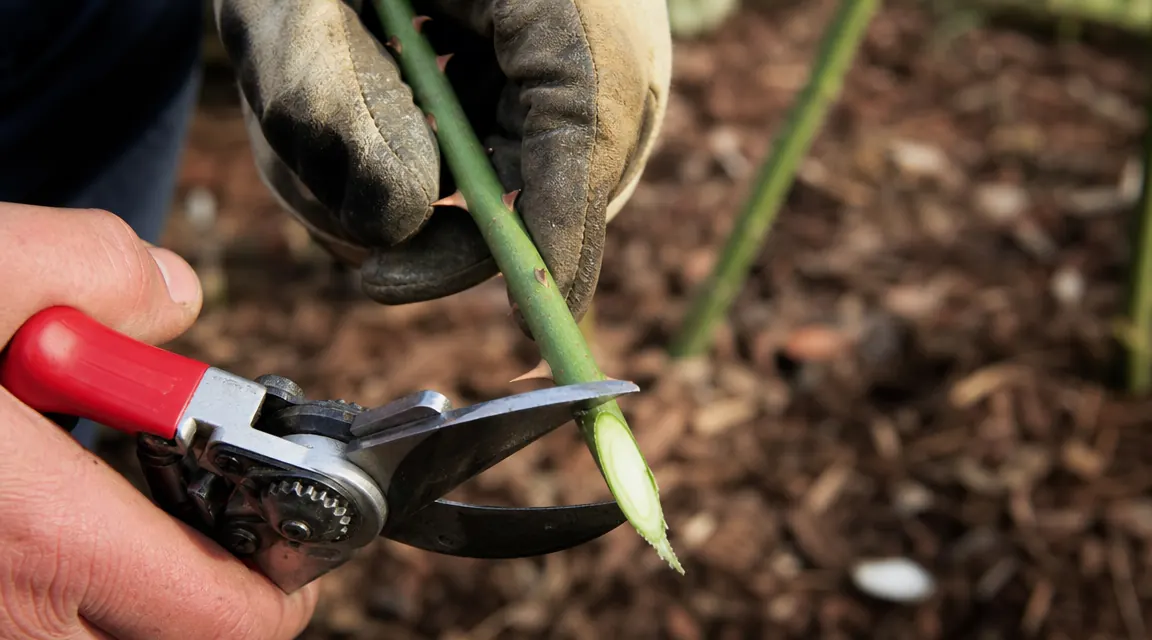
One detail that does not get enough attention: the spring between the handles. The coiled return spring reopens the blade after each cut so you do not have to manually pull the handles apart. On a long pruning session this reduces cumulative hand fatigue meaningfully. The concern some reviewers raise is spring fatigue over time, and it is a legitimate question for heavy commercial use. For a home gardener pruning a few hundred cuts per season, the spring typically holds up for several years before showing any weakness. When it does eventually weaken, a replacement spring is inexpensive and swaps in minutes.
The Honest Comparison to Fiskars
The Fiskars bypass pruner is the most common alternative to the Felco at roughly half the price. Here is the honest take: Fiskars makes a solid tool at a fair price and for light to moderate garden use, it performs well. The blade steel is softer than Felco's, which means it dulls faster under heavy use, and the pivot is not adjustable. Fiskars also does not offer replaceable blades, so when the edge is truly gone, you replace the whole tool. For a gardener who prunes two or three times a year on light growth, the Fiskars is a completely reasonable choice and the Felco price premium is hard to justify.
For a gardener who prunes weekly during the growing season, cuts established rose canes, apple tree suckers, or woody hydrangeas regularly, and wants a tool that stays sharp across a full season without constant sharpening, the Felco F5 earns its premium in the first year. The two tools are not really competing for the same buyer. If you want the full side-by-side breakdown, my Felco F5 vs Fiskars comparison covers every spec difference and which gardener each one is right for. The short version: the Fiskars is the right tool until your pruning tasks get heavy enough that edge retention and adjustability start to matter.
What I Liked
- Hardened steel blade holds a sharp edge through months of regular use without frequent sharpening
- Adjustable pivot bolt lets you tune blade tension to match your cutting preference
- Sap groove on the counter blade prevents buildup during long pruning sessions
- Fully replaceable parts system means the tool is maintainable for the long term
- Consistent build quality unit to unit, reflecting Swiss manufacturing standards
- Coiled return spring reduces hand fatigue on high-volume cutting sessions
- Wire-cutting notch at blade base handles plant ties and 14-gauge wire cleanly
Where It Falls Short
- Sized for large hands only; medium and small-hand gardeners need the F2 or F6 instead
- Rotating lock lever requires deliberate two-finger pinch, which is awkward with wet or dirty gloves
- Felco does not publish steel alloy specs, so you are trusting performance over published data
- Blade replacement requires pivot disassembly; not difficult but not instant either
- Clean one-cut performance drops noticeably above 0.9 inches despite 1.2-inch rated maximum
Who This Is For
The Felco F5 is the right pruner for home gardeners with large hands who cut roses, fruit trees, woody ornamental shrubs, or perennial stems on a regular basis throughout the season. If you are pruning every week or two during the growing season and have been frustrated by dulling blades, loose pivots, or springs that give out, the F5 solves all three of those problems at once. It is also the right call for anyone who wants a single high-quality tool they can maintain for years rather than a rotation of cheap replacements. The long-term math favors the Felco clearly once you factor in replacement costs on budget pruners. If you want to understand the full case for choosing bypass over anvil-style pruners, my piece on the Felco F5 long-term use review covers the mechanical differences in detail.
Who Should Skip It
If your glove size is medium or small, skip the F5 and look at the Felco F2 or F6. Buying the wrong grip size means buying the wrong tool. If you garden occasionally and your pruning tasks are light, a quality mid-range pruner at half the price handles the job and the Felco premium is not justified. If most of what you cut runs thicker than an inch in diameter, invest in a quality lopper rather than asking a hand pruner to do work it was not designed for. And if you have no interest in any maintenance relationship with a tool, a no-fuss replaceable pruner at lower cost is the more practical choice.
Stop replacing cheap pruners every season. The F5 is the last hand pruner you buy, if you buy the right size.
Swiss-made blade steel, adjustable pivot tension, replaceable parts down to the spring. The Felco F5 is built to last decades with basic maintenance. Check today's price on Amazon and see what size fits your hands before you order.
Amazon Check Today's Price on Amazon →